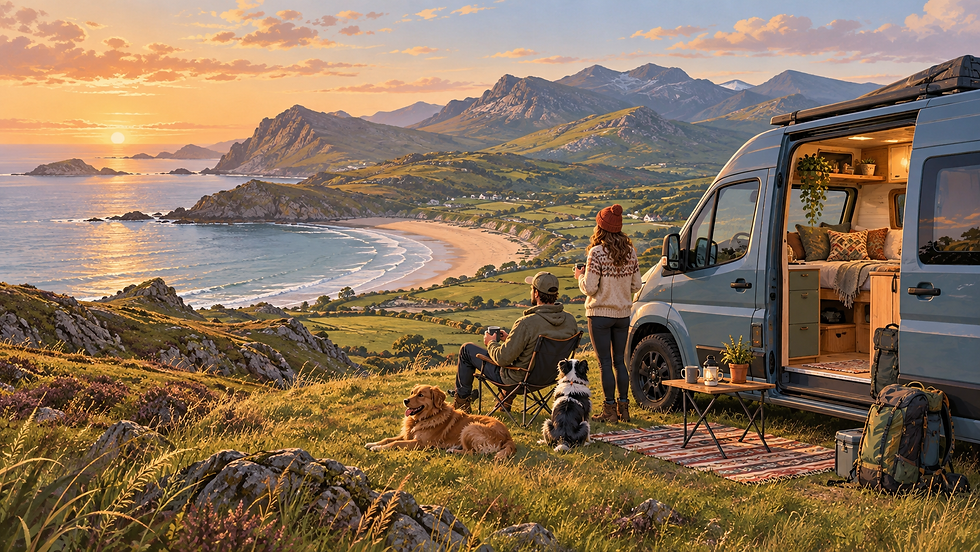
Cornwall Campervan Road Trip: The Ultimate Van Life Guide


There are places that are good for campervans.
And then there's Cornwall.
Few parts of Britain suit van life quite so naturally. Drive west for long enough and the roads get smaller, the coastline gets wilder and suddenly spending the evening sitting outside a campervan with a mug of tea seems like an entirely reasonable life choice.
A Cornwall campervan road trip gives you surf beaches, fishing harbours, enormous cliffs, tiny villages, subtropical gardens, coastal walks and some of the finest sunsets in Britain.
It also gives you single-track lanes bordered by stone walls.
We'll get to those.
Whether you're visiting Cornwall for a long weekend or spending several weeks slowly exploring the peninsula, this guide will help you plan a campervan trip without turning it into a frantic attempt to visit every beach in the county.
Why Cornwall Is So Good for Van Life
Cornwall feels like it was designed for road trips.
You can wake near the north coast, spend the morning walking above Atlantic cliffs, stop somewhere for a pasty and end the day watching the sun disappear into the sea.
And although Cornwall looks relatively small on a map, there is enough here to fill several trips.
The north coast tends to feel wilder and more exposed.
The south has sheltered coves, wooded estuaries and old harbour towns.
Then there is the far west, where the landscape becomes increasingly rugged until Britain rather dramatically runs out of land.
The mistake is trying to do all of it at once.
A Cornwall campervan road trip is far better when you slow down.
When Is the Best Time for a Cornwall Campervan Road Trip?
July and August bring the warmest weather, busiest beaches and greatest competition for campsites and parking spaces.
They're also when some of Cornwall's narrow roads become an elaborate negotiation between campervans, delivery vans, cyclists and tractors.
For van life, we'd seriously consider May, June or September.
The days are still long, many seasonal businesses are open and the roads generally feel less frantic.
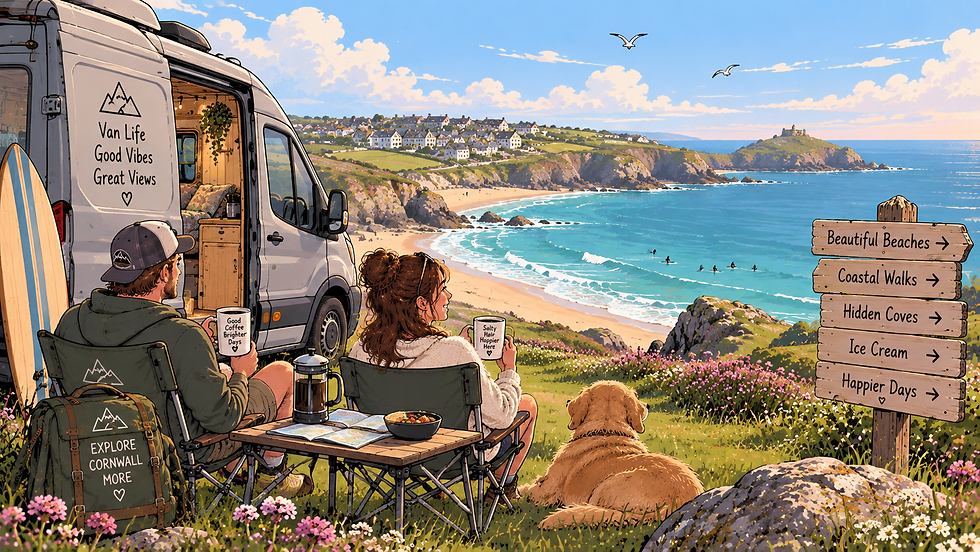
Spring can be beautiful.
Autumn can be spectacular.
Winter brings empty beaches and dramatic weather, although campsites and attractions are more limited.
Whatever the month, bring waterproofs.
This is Britain.
Optimism is lovely, but Gore-Tex is more reliable.
The Best Places to Visit in Cornwall by Campervan
You could build dozens of different Cornwall routes.
For a first trip, these are some of the places we'd put near the top of the list.

Bude
If you're entering Cornwall from the north, Bude is a brilliant place to start.
You've got beaches, surf, coastal walks and enough shops and facilities to stock the van before heading farther west.
It also gives you that first proper glimpse of the Atlantic coastline.
Tintagel
Tintagel does drama rather well.
Cliffs, legends, a castle and huge coastal views make it an obvious stopping point on the north coast.
The village can become busy, so arriving early or visiting outside peak summer makes everything easier.
Padstow
Padstow is polished, popular and very good at feeding people.
Walk around the harbour, follow a stretch of coast or cycle part of the Camel Trail.
Then buy something containing more butter than is strictly necessary.
You're on holiday.
Newquay
Newquay is one of Cornwall's best-known surf destinations and makes a useful base if you want beaches, nightlife and easy access to the north coast.
Fistral Beach gets most of the attention, although there are plenty of alternatives nearby.
St Ives
St Ives may be absurdly pretty.
White sand, clear water, old streets, galleries and sea views combine into something that occasionally looks more Mediterranean than British.
The downside?
Everyone else noticed.
Trying to drive a larger campervan through central St Ives during summer isn't high on our list of relaxing activities.
Park outside and walk or use local transport where possible.
Land's End and Sennen
Keep driving west and eventually you'll arrive at one of Britain's most famous edges.
Land's End itself is well known, but we'd make time for the surrounding coastline rather than simply taking the obligatory photograph and leaving.
Nearby Sennen has a magnificent beach and gives you access to superb stretches of the South West Coast Path.
Porthcurno
Turquoise water.
Golden sand.
Granite cliffs.
Porthcurno doesn't exactly struggle in the scenery department.
The Minack Theatre overlooking the coast makes this part of Cornwall particularly memorable.

Parking becomes extremely busy in summer, so this is another place where early starts pay off.
Mousehole
Tiny streets curl around one of Cornwall's loveliest harbours.
Mousehole is exactly the sort of place where the campervan is best left somewhere sensible before exploring on foot.
Your wing mirrors will thank you.
The Lizard Peninsula
The Lizard feels slightly removed from the busier rhythm of Cornwall.
There are beautiful coves, open countryside and dramatic coastline, including Britain's most southerly point.
It's a great area for slowing the trip down.
Falmouth
If endless tiny villages have left you craving somewhere with shops, pubs and a bit more going on, Falmouth is a good reset.
The harbour town has plenty of maritime character and makes a useful base for exploring the surrounding south coast.
North Cornwall or South Cornwall?
If you've only got a few days, pick one.
North Cornwall is the obvious choice if you want:
surfing
big Atlantic beaches
dramatic cliffs
sunsets
rugged coastal scenery
South Cornwall works beautifully if you prefer:
harbour towns
sheltered coves
estuaries
gardens
gentler coastal scenery

Neither is better.
And you'll probably end up coming back to do the other one anyway.
That's how Cornwall gets you.
Where Can You Stay Overnight in a Campervan in Cornwall?
Do not assume that a car park allowing vehicles during the day automatically permits overnight sleeping.
Cornwall Council currently allows overnight stays by self-contained motorhomes with an onboard toilet in certain council car parks, including locations in Bude, Falmouth, Fowey, Marazion, Newquay, Padstow, Perranporth and St Ives. Individual car park rules and charges apply and can change, so check the current council information before arriving.
There are also plenty of campsites throughout Cornwall, ranging from large holiday parks to tiny farm sites with little more than a field and an extraordinary view.
Honestly, some of the small ones are hard to beat.
Driving a Campervan in Cornwall
Now we need to discuss the lanes.
Cornwall contains perfectly ordinary A-roads.
It also contains roads that appear to have been designed when the principal mode of transport was a determined goat.
Do not blindly follow your sat-nav.
If a shortcut looks suspiciously narrow on the map, there's a reasonable chance it is suspiciously narrow in reality.
For larger vans:
stick to main roads where possible
check routes before setting off
watch your width as well as your height
use passing places properly
avoid travelling through popular villages at peak times
don't be afraid to take the longer route
Three extra miles on an A-road is often preferable to twenty minutes staring at a Cornish hedge while reversing uphill.
How Long Do You Need in Cornwall?
For a Cornwall campervan road trip, we'd suggest:
3 nights: Choose one part of Cornwall and stay fairly local.
5–7 nights: Enough time for a north-to-west or west-to-south route.
10–14 nights: You can properly slow down and explore most major areas without spending every day driving.
If you've only got a weekend, don't try to reach every famous location.
Choose a good base.
Park the van.
Walk.
Eat.
Explore.
Repeat.
Cornwall Campervan Road Trip: A Simple 7-Day Route
A relaxed first route might look something like this:

Day 1 – Bude
Arrive, find your feet and explore the coast.
Day 2 – Tintagel and Boscastle
Take your time on the north coast and enjoy some dramatic cliff walking.
Day 3 – Padstow
Explore the harbour and surrounding coastline.
Day 4 – Newquay
Beach day.
Surf if you're feeling energetic.
Watch other people surf if you're not.
Day 5 – St Ives
Leave the van somewhere sensible and spend the day exploring on foot.
Day 6 – Sennen, Land's End and Porthcurno
This is Cornwall at its most dramatic.
Day 7 – The Lizard or Falmouth
Finish with the softer landscapes of the south coast.
Don't treat that itinerary as an instruction manual.
If you find somewhere you love on day three, stay.
That's the advantage of bringing your bedroom with you.
What to Pack for Van Life in Cornwall
Besides normal campervan equipment, bring:
waterproof jacket
walking shoes
beach towel
warm evening layer
small backpack
reusable water bottles
levelling ramps
windbreak if you use one
OS maps or downloaded offline maps
binoculars
wetsuit if you're planning to surf or swim

And don't forget sun cream.
Cornish wind can make it remarkably easy to forget that the sun is slowly cooking your forehead.
Campervan Etiquette in Cornwall
Cornwall sees huge numbers of visitors.
That makes responsible van life particularly important.
Don't block access.
Don't leave rubbish.
Don't empty grey water or toilets irresponsibly.
Don't treat ordinary parking spaces like campsites by spreading furniture everywhere.
And if a sign says no overnight parking, find somewhere else.
The easiest way to keep beautiful places welcoming campervans is not to give anybody a reason to ban them.
Is Cornwall Worth Visiting in a Campervan?
Completely.
Cornwall combines everything that makes van travel enjoyable: short distances, spectacular scenery, outdoor activities, brilliant food and dozens of places where you'll want to stay longer than planned.
Yes, it gets busy.

Yes, some lanes will make you question the accuracy of your vehicle-width measurements.
And yes, there will inevitably be a seagull that develops an unhealthy interest in your lunch.
But sitting outside your campervan as the sun goes down over the Atlantic tends to make all of that fairly easy to forgive.
A Cornwall campervan road trip isn't about ticking off every famous beach.
It's about slowing down enough to find the ones you weren't looking for.