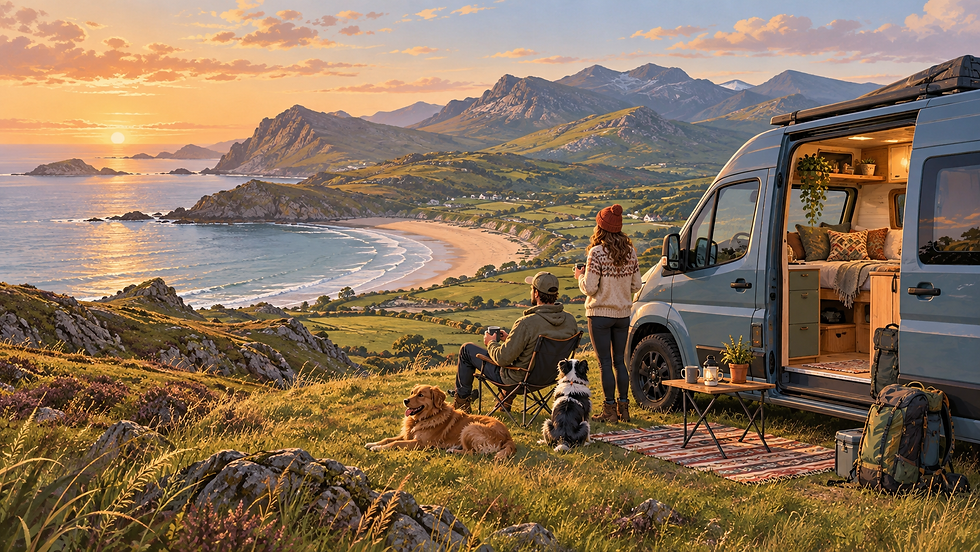
Scottish Highlands Campervan Road Trip: The Ultimate Van Life Guide


There is a moment on almost every Scottish Highlands campervan road trip when you stop speaking.
Not because anything is wrong.
Quite the opposite.
You round a corner and suddenly there is a mountain, a loch or a huge empty valley in front of you and for a few seconds there isn't really much worth adding.
Scotland does that.
The Highlands are one of the closest things Britain has to a proper wilderness road trip.
But this isn't a theme park.
People live here.
Communities use the roads.
The landscapes are fragile.
And the popularity of campervans means travelling responsibly matters more than ever.
Do it properly and this could be one of the best van trips you'll ever take.
Why the Scottish Highlands Are Perfect for Campervans
Space.
That's the first thing you notice.
The landscape opens up and ordinary journeys start feeling like adventures.
You can travel between mountain ranges, sea lochs, beaches, forests and tiny villages in a single day.
The Highlands also reward the thing campervans do particularly well:
Changing the plan.
You might intend to drive another 50 miles.
Then the light hits a loch.
The kettle goes on.
Suddenly those 50 miles seem rather less important.
When Should You Visit the Highlands?
Every season changes the experience.
Spring
Longer days begin returning, the landscape wakes up and many areas remain relatively quiet.
Summer
You get extraordinarily long daylight hours.
You also get more visitors.
And midges.
Tiny flying proof that no paradise is allowed to become too smug.
Autumn
One of our favourite times.
The colours can be spectacular, roads quieten down and cooler nights make the campervan feel especially cosy.
Winter
Beautiful, but serious.
Short daylight hours, snow, ice and rapidly changing weather mean winter Highland travel requires much more preparation.
Where Should You Go?
The Highlands are huge.
Please don't try to see everything.
You can't.
And rushing around trying is one of the easiest ways to completely miss why the place is special.
Glencoe
If you want immediate Highland drama, Glencoe delivers.
Mountains rise steeply around the road and almost every lay-by appears to contain somebody staring upwards.
Take time to walk.
The valley looks impressive through a windscreen.
It looks considerably better when you're standing in it.

Fort William
Fort William isn't necessarily the prettiest Highland town, but it is extremely useful.
Stock up.
Refuel.
Eat.
Use it as a base.
Ben Nevis and Glen Nevis are nearby, and several major routes meet here.
Glenfinnan
The famous railway viaduct brings plenty of visitors, but the wider landscape deserves attention too.
Arrive early if you want a quieter experience.
Isle of Skye
Technically an island rather than simply another Highland stop, but it ends up on a huge number of campervan itineraries.
For good reason.
The landscapes are extraordinary.
The roads and parking can become extremely busy.
Again: slow down.

Applecross
The Applecross Peninsula is spectacular.
The famous Bealach na Bà road is also steep, narrow and not suitable for every vehicle or driver.
There is an alternative road.
Using it does not make you less adventurous.
It makes you somebody who still has both wing mirrors.
Torridon
Torridon is Scotland turned up slightly too far.
Huge mountains.
Open landscape.
Lochs.
Very few distractions.
Spend time here.

Ullapool
Ullapool is an excellent Highland campervan stop.
It gives you shops, food, fuel and civilisation before or after exploring more remote country.
Assynt
North of Ullapool the landscape becomes increasingly extraordinary.
Mountains rise individually from vast open ground, creating scenery unlike almost anywhere else in Britain.
Durness
Remote beaches, huge skies and that satisfying feeling that you've travelled a very long way north.
Because you have.
What About the NC500?
The North Coast 500 transformed how many people discover northern Scotland.
It's a spectacular route.
But it isn't mandatory.
You are allowed to visit the Highlands without completing a branded loop.
In fact, some of the best Highland trips deliberately explore smaller areas more slowly.
Rather than asking:
“How quickly can we do the NC500?”
Ask:
“Which part would we actually like to experience?”
Much better question.
Overnighting in a Campervan in the Highlands
This area has changed significantly, so always check current information.
Highland Council operates a Campervan and Motorhome Scheme for self-contained vehicles. Its designated overnight car parks currently operate under specific conditions, including overnight periods, waste-disposal requirements and restrictions on activities outside the vehicle.
As of the council's July 2026 update, the scheme offers a seven-day membership for designated facilities and participating locations. Check the current council page before travelling because locations, pricing and conditions can change.
And remember: Scotland's access rights don't simply mean campervans can park and camp anywhere they fancy.
Motorised access is a different matter.
Use campsites and authorised overnight locations, follow signs and don't create your own campsite in a lay-by.

Driving Highland Roads
This is where patience becomes useful.
Single-track roads are normal.
Passing places are normal.
Meeting a sheep standing in the exact location you'd ideally like to drive is also fairly normal.
On single-track roads:
look well ahead
use passing places
allow traffic behind you to pass
don't park in passing places
slow down around blind bends
expect cyclists and walkers
be considerate to local traffic

If you notice a queue developing behind your campervan, pull into a suitable place and let people through.
The scenery will still be there afterwards.
Fuel, Food and Water
Distances between services increase quickly in remote parts of the Highlands.
Don't operate on the principle that you'll fill up “at the next place”.
Sometimes the next place is surprisingly next.
Keep a sensible amount of fuel.
Top up drinking water when you can.
Carry food.
And download offline maps before heading into remote areas.
Mobile signal has improved enormously, but the mountain doesn't care how many bars your phone usually gets.
A Relaxed 7-Day Highlands Campervan Route
Rather than attempting the entire north of Scotland, try something like:
Day 1 – Glencoe
Walk, explore and stop rushing.
Day 2 – Fort William and Glenfinnan
Restock and continue west.
Day 3 – Skye
Choose one section of the island.
Do not attempt to conquer Skye in an afternoon.
Day 4 – Skye
Yes.
Another day.
You'll understand when you're there.
Day 5 – Applecross or Torridon
Take the route that suits your van and driving confidence.
Day 6 – Torridon to Ullapool
One of those days where stopping repeatedly is unavoidable.
Day 7 – Ullapool and Assynt
Finish farther north — or stay.
We won't tell anyone.
Midges: We Need to Talk About Them
Scotland's most famous tiny residents deserve their own section.
Midges are most active during the warmer months and particularly enjoy still, damp conditions.
Bring repellent.
Use mesh screens.
Avoid leaving doors open unnecessarily.
A beautiful lochside evening can go from peaceful to “EVERYBODY GET INSIDE” with impressive speed.
Leave the Highlands Better Than You Found Them
Don't litter.
Don't dump waste.
Don't block access.
Don't light irresponsible fires.
Don't turn passing places into campsites.
Don't empty toilets anywhere except proper disposal points.
And spend money locally.
Buy fuel.
Use cafés.
Visit local shops.
Stay on campsites.
Have dinner in the pub.
The Highlands aren't simply scenery.
They're home to communities.
Is a Scottish Highlands Campervan Road Trip Worth It?
Without question.
But the Highlands aren't at their best when treated like a checklist.
Drive fewer miles.
Stop more often.
Walk somewhere.
Stay two nights instead of one.
Watch the weather change.
Make coffee beside the van.
Talk to people.

Take the road that wasn't originally part of the plan.
The best Scottish Highlands campervan road trip probably isn't the one where you can tell everybody how many miles you completed.
It's the one where, three days in, you stop caring.